Frontline Nurses: Ebola
Christiana Conteh
Acting Coordinator for Infection Prevention and Control, Ministry of Health
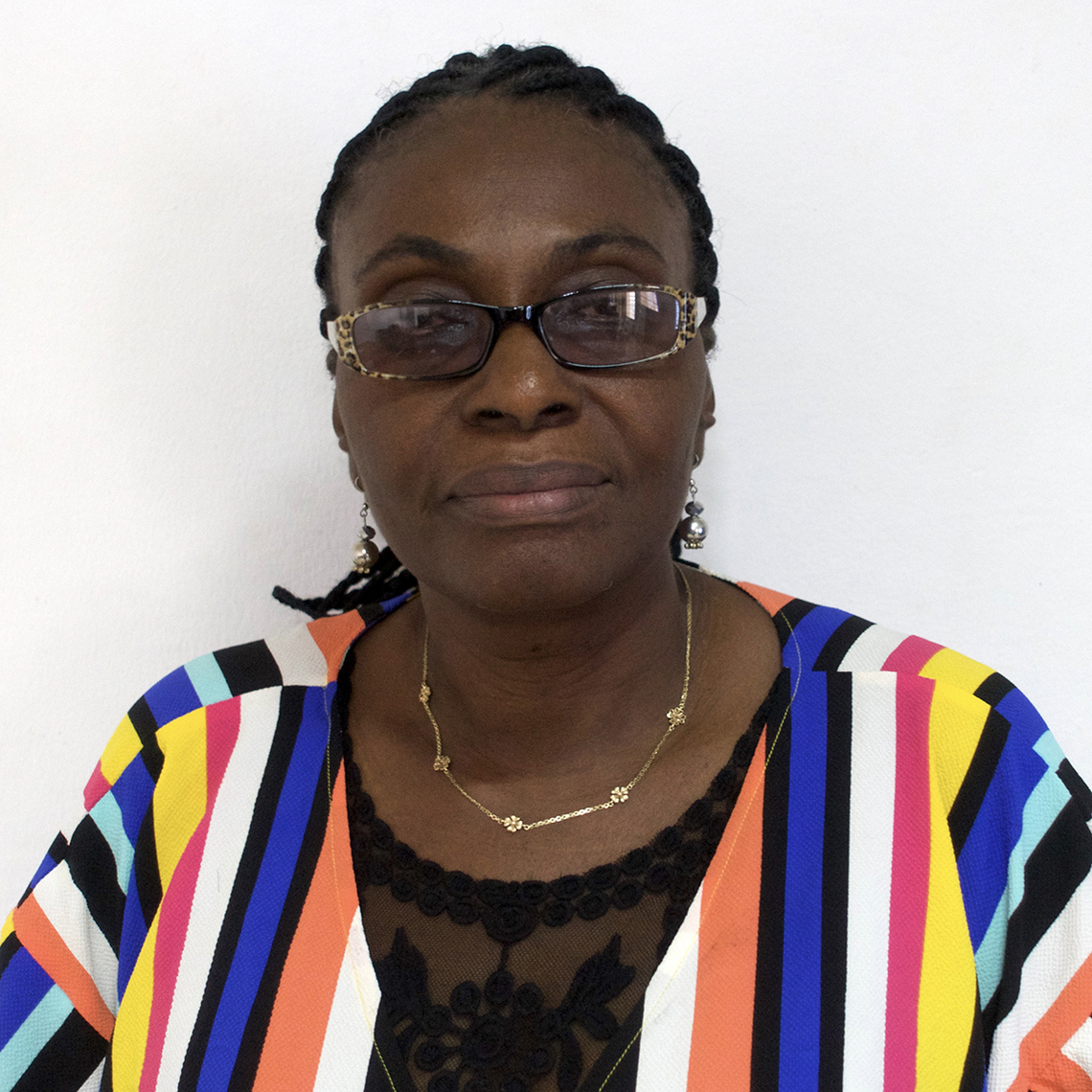
Christiana Conteh is the acting coordinator for the Ministry of Health's Infection Prevention and Control program. Conteh is a graduate of both the National School of Nursing and the National School of Midwifery, as well as a holder of a diploma in public health. During the Ebola epidemic, she trained nurses and healthcare workers across the country about infection prevention and control.
Q: What was your role during the Ebola outbreak?
CC: I am the acting coordinator for infection prevention and control program at the ministry of health. I entered the Ministry of Health National School of Nursing in 1981, and I trained as a state registered nurse in 1984. Since then, I have been working in all of these hospitals, pediatric hospital, maternity, and in the general hospital. Then I did my midwifery at the National School of Midwifery in 1989 and I became a state certified midwife. I practiced for a while, then I went further to do my public health degree. I did public health in 1994, and in 1995 I earned a diploma in public health. Later, there was a dire need of anesthetists. In the whole country, we had only one doctor anesthetist, and I trained as a nurse anesthetist.
In 2014, I was still a nurse anesthetist when we go the call about the Ebola outbreak. I was the education officer of the Sierra Leone Health Services Workers Union. As an organization, we said, “Let us go out to educate our members.” We had the support of the ministry. We had a small taskforce that was set to come up with comprehensive plans and recommendations to the government. We saw it was very clear that there was nothing like infection control in all of these facilities. So one of our strongest recommendations to the government was that we really wanted to see infection control in all healthcare facilities.
And then a few weeks after, I think we had consultative meetings with WHO [World Health Organization]. Our recommendations also captured training of healthcare workers, because there was a lack of training. It was a real crisis. We had a training of the trainers on the infection control and Ebola outbreak. This was done in September 2014. I was one of the participants.
By then, we were having more cases of Ebola. More people were dying and people were so scared. Nobody actually wanted to move forward, you know. But four of us persevered and we started training healthcare workers. We trained nurses, clinicians, and non-clinicians. We prepared them for the Ebola treatment centers, ETUs. For three months, I was donning and doffing PPE [personal protective equipment] during the training sessions, because we had trainings three days each. Before that, many of our facilities were abandoned. Nurses were afraid.
In January 2015, we had the second training. Seventy-five in total were trained, basic IPC training. And out of the seventy-five, we had IPC focal people appointed. We were posted to different facilities. I was at Connaught Hospital, the main referral hospital, as an IPC focal, to train all the healthcare workers. In July, I was moved to the National Infection Control Unit as a training coordinator and we established the National Unit in the Ministry of Health and Sanitation. In 2018, I was actually moved to act as the national coordinator for IPC.
Q: So you mentioned there was a WHO consultant.
CC: Yes. But during the outbreak, we had other partners. And supporting IPC was CDC [Centers for Disease Control] in Atlanta. They pushed the government so hard. CDC supported the establishment of the national unit in the ministry, in terms of office space, training, support for the unit.
Q: Do you remember how many you’ve trained so far?
CC: Yes, for Ebola I trained close to six thousand healthcare workers. Six thousand healthcare workers, both clinical and nonclinical, both in Western Area and in the regions together.
Q: And during your work, did you come in contact with grieving families or lost colleagues or—
CC: Not only coming into contact with grieving families. I was also grieved. I lost a brother. One of the doctors, the specialists that we lost, was a brother. And a close friend too died, the entire family got wiped out. So that gave me the zeal to actually be more committed and it added a passion in me for infection control. Because I know that with knowledge of infection control, they would not have died. The specialist, the surgeon had so much passion that even during the outbreak, he was still performing surgery. He became infected and we lost the entire family. The only surviving daughter was in Australia. The entire household died.
Q: How was it to deal with that loss?
CC: I was even in Moyamba training for their ETU when she called me and asked, “Christiana, are you at home?” We live just a few meters apart from each other. I said, “No. I am—you know I’m in Moyamba. Any problem?” “Yes. I had frequent stools last night and this morning, I started vomiting.” I said, “Oh, my God. You started vomiting. Let me call so that they can pick you from the house to the facility.” She said, “No Christiana, I’ve taken the ORS [oral rehydration solution].” Then I kept calling. I kept calling but later in the day, I got the husband and the husband told me, “Oh, she’s not improving.” They took her straight to a holding center and collected a sample. As soon as the result was out in the evening, they told me she was positive. I was broken. Honestly.
I called the husband. I called the children, you know. I had to inform the holding center. I gave the number of inhabitants in the house so they can keep monitoring them. They transferred her to the treatment center. She died before the day ended. It was not easy. I couldn’t come to her because even when you come, you cannot reach out. The moment I was planning to come, I had another call that my brother was taken to the ETU. He had a fever. Two days after, he died. It was not easy. It was really not easy. Even when you go to the burial site, you cannot pay your last respects. You are standing far away. From that moment actually, I had passion for infection control. That has actually motivated me for the past years to continue to work in this unit.
You know what it means actually when you see colleagues die? Everybody was frightened. Nobody wants to go to the facilities. In Connaught Hospital where I was the hospital focal, we had a holding center. You come in the morning and the ambulance comes. And you see the piling corpses on top of corpses. Oh, my God. It’s like you look at yourself and say, “What am I doing here? I don’t want anything. I don’t want to be living.” But then, we have to turn around again to reassure colleagues. We have to continue working. We signed—we took a pledge yesterday to save life of humanity. So we have to go back to the wards to work.
During the trainings, you reassure them. You give them a tap on the back. You encourage them to follow the standards, to work safely, so that we can break the chain of transmission. during the Ebola outbreak here, we saw clearly there were lapses in infection control. We had no control over resources. We had limited supplies. You have to look at the whole system, the supplies. You also have to back it up with trainings because people have to be knowledgeable enough for them to follow the rules and guidelines. And then of course, you have to do regular monitoring. That is what we are doing now as a national unit. We’re making sure we’re doing trainings. We are monitoring the facilities, supervision, mentorship, encouraging healthcare workers so that we can actually minimize the spread of infection within the healthcare setting.
Q: What about the impact on women? In the nursing profession, where there are more women, and also in the community, how did it play out in this?
CC: Women carry all the burden when someone is sick. It’s the women. It’s the mother, the wife, the daughters. They’re the ones who give care, who provide the care at home. So when you actually look into the infection rate during the outbreak, more women were infected than men. They are mothers. They have to take care of the babies. They have to take care of the family. As nurses, it was not actually easy for us because when these patients do come, we give care. You see a little girl. A patient is admitted. You really want to go closer to call to that child, reassure that patient. As a result, a lot of healthcare workers were infected. It was no secret. We are hands-on. We are caring for patients hands-on with limited resources. We don’t have sophisticated equipment. So lack of the knowledge and passion for the job actually led to the high infection rates among the healthcare workers.
One of the challenges we actually faced, when we started pushing for infection control, we had a lot of doctors pushing away from us. They said, “What can the nurses know? A nurse cannot teach me. I am more educated than these nurses. Why should they come and teach me?” But then they actually saw the impact we created. Gradually, we had to win them over. And they started coming for the trainings. Some men don’t actually believe that a woman can lead, can be a boss, that a woman knows anything more than me as a man. So that was one of the confrontations.
Gradually with the implementation of the measures in their facilities, they came to realize that, you know what, we have to reckon with these nurses, because the nurses are with the patient twenty-four/seven and they are hands-on. A doctor can come to the unit. The doctor can never touch except they touch the notes. But the nurses are hands-on. They started listening to nurses. And, you know, a nurse can actually come and say, “Doctor, I want you to work safe.” “Doctor, you have to perform hand hygiene. You have to wash your hands.”
Also as a mother at home, during my involvement in the outbreak, it was not easy for me. I had to push away my children. I told them I don’t want that bonding for as long as I am in the facilities. I had my own corner, I had my room. We can talk but we are not actually close together.
And I told them, if I am to be infected, let me be infected alone. I don’t want infection to spread. I don’t want you to die. If I am going to die, let me die alone and you will live to tell the story. So in the morning when I’m leaving for work, you know, I have my grandchildren at home. My daughter, my son, they are all there. And everybody will just keep away, “Goodbye, mom. Good luck.” I say, “Good luck. I’m coming back.” When they hear my voice, you know, everybody rushed towards the door and they said, “Oh, mommy. Good evening. Good evening. Oh, grandma, how are you?” And they will have to move back. Even my husband had to move from the bedroom. [laughs] He had to move to another room. So I was virtually alone for 2014 and 2015. Until ‘15, yes, 2015. Life was now a bit different. And we actually started working together again. The bonding, we started bonding again together. But it was rather unfortunate. At that time, a month after, my husband died. He died.
Q: He died of Ebola?
CC: No, no. He didn’t die of Ebola but we were still having the safe burial protocols, that every funeral, every burial—the burial team has to bury that corpse. My father died was a very old man, 106 years. He was very old. But they had to put him in the body bag. And I saw the burial team taking my father, whom I knew was not infected, because their own location, their village, there was no Ebola outbreak in their own surroundings actually, immediately. So there was no infection of Ebola there, but that was the national protocol. I looked at them. They put my father in a body bag. I couldn’t even get closer to my father. I had to walk a distance away from the ambulance until they got to the cemetery. But yet I said, “No, I am a nurse and I am going to continue to be in this. I will stay away.” So that is the passion I have for infection control.
Q: You are doing so much with infection control. What do you think is the general outlook among health workers and the communities since Ebola has been coming down? Do you think things have changed?
CC: Habit, behavior, is something that is very difficult to win over. We’re having a major challenge amongst healthcare workers, the behavioral change. It is very clear that hand hygiene alone can actually remove up to eighty to ninety percent of microorganisms. But to get healthcare workers to comply with hand hygiene is a big challenge. It’s also constant monitoring. You have to monitor constantly, use mentorship and on-the-job trainings.
Amongst the community, we had a lot of negative feedback. When you tell them to wash their hands, they tell you, “If I wash my hands, do you have food to give me?” A whole lot of people dropped hand hygiene despite ongoing sensitization, health education, and community engagement. We still have to work at it to win them over. There are also still people in our community who don’t believe in going to a healthcare facility. They go to the traditional healers. How can we change that one? It’s a bit difficult because that’s their belief. They will tell you it’s not a “hospital sickness.” But by and large, we are really pushing. We are trying. You know, our country, every year we have had a cholera outbreak. But since the Ebola outbreak, when there was this consciousness of handwashing, this has improved. Since 2014, we have not had a cholera outbreak in Sierra Leone.
Q: Thank you so much. Is there anything you want to add before I close out our discussion?
CC: I want to say that nurses have been instrumental and have been the pivot of our success today and during the outbreak in 2014-2015. Nurses have worked hard and under difficult conditions. But yet, there is still commitment from the nurses, the healthcare workers. They are committed to save lives, even with the limited resources that we have. There are things to change but because nurses don’t have the opportunities, don’t have the capabilities, that’s the frustrations that nurses have. You want things to happen but you are not in authority to make sure it happens. So that’s the frustration that nurses actually have. Nurses have been instrumental and we’ve kept our promise, our pledge to save the lives of our people in this part of the country. So that’s our commitment and we stand and we continue to do that.
Christiana Conteh was interviewed for Frontline Nurses by Annette Mwansa Nkowane on August 13, 2019 in Freetown, Sierra Leone.